
Fault finding and guidance to repair your microwave system.
Magnetron Failure
The magnetron can fail in several ways, producing obvious visual symptoms that can be seen and require no testing with a meter.
Magnetron Replacement Considerations
1. Be careful not to strike or touch the antenna dome area.
2. Transfer any add-on parts, such as an air duct, thermal fuse, or cut-out’s.
3. Ensure that the wire mesh RF gasket is intact and in place.
4. Examine the rim of the opening where the magnetron dome is to be inserted into the waveguide. Smooth out any irregularities such as dents, pits and burns. The rim surface should be bare metal and smooth to the touch. Use light-grade sandpaper—do not use steel wool.
5.If there is evidence of poor terminal connections (i.e., discoloured, burned, pitted connectors), repair or replace the slip-on connectors on the filament leads.
6. If possible, perform an RF leakage check around the magnetron.
The following is a pictorial list of common visible magnetron failures, along with their respective symptoms and solutions.
Terminals showing signs of burning.
Insulator breakdown begins with a tiny, burned spot on the magnetron insulator. With each subsequent cook cycle, stronger arcing and burning progressively occur, eventually leaving clear visual evidence of the failure, as shown in the picture to the right.
Symptoms: Loud hum, no heat, arcing sound, electrical burning smell
Solution: Replace the magnetron and change the terminals, ensuring they fit correctly.
Cracked Magnet(s)
This is caused by the magnetrons overheating. In some instances it is caused by reflected microwave energy, poorly designed or tuned cavities or waveguide launches.
Symptoms: Weak or no heat, magnetron gets extremely hot (overheats), intermittent arcing or “snapping” sound
Solution: Check for signs of reflected microwaves or faulty cooling fans. It can also be caused by poorly designed or tuned cavities or waveguide launches.
Burnt or Melted Antenna Cap.
Burned Dome ( Antenna) caused by arcing due to reflected microwave energy (Feed Back). Check for a stalled or arcing stirrer blade or non-rotating antenna assembly when this occurs. In many commercial models with multiple magnetrons, the cooking tray must be raised to inspect the condition of the lower antenna assembly, or you may see this inside the cavity.
Symptoms: Weak or no heat, arcing sound during the cook cycle
Solution: Replace the magnetron and, if necessary, the respective antenna or stirrer assembly. Clean the cavity where the arcing has happened. Too much carbon build-ups will cause the arcing to return within a very short period.
Loose Magnetron Terminals
Loose Magnetron Filament Connectors / Discoloration of the connector(s) or plastic insulator(s).
If the connectors that slip onto the magnetron filament terminals become loose or are improperly crimped, it causes a build-up of resistive heat. As this occurs, the connection further deteriorates, causing the following visual symptoms: Small blackened pits in the magnetron terminal(s)
Melted and decayed appearance.
Also, as noted above, an unusually fearsome spark is produced when discharging the capacitor.
Symptoms: Intermittent and low heat initially, then eventually no heat.
Solution: Repair defective terminals as follows:
Either (1) Clean the burned/pitted magnetron terminals and replace the slip-on connectors, making sure they fit tightly on the terminals.
(2) Cutaway burned wire and connector(s). (Make sure there is enough remaining wire to reach with some slack) Clean terminals to prepare for soldering. Solder the filament leads directly to the magnetron. Be careful not to apply soldering heat any longer than necessary.
Discoloured or burnt gasket and or antennas
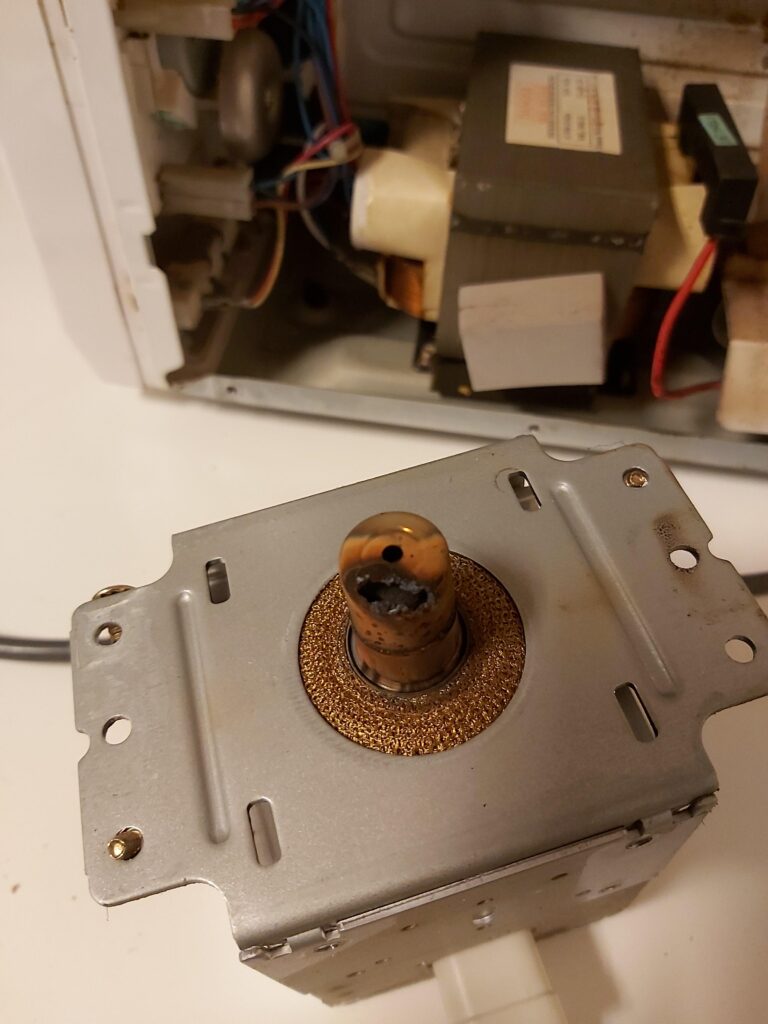
The gasket you can see above, should be a bright copper colour. However, it’s dark brown colour that indicates it’s got very hot due reflected power inside the cavity or arcing inside the waveguide launch itself.
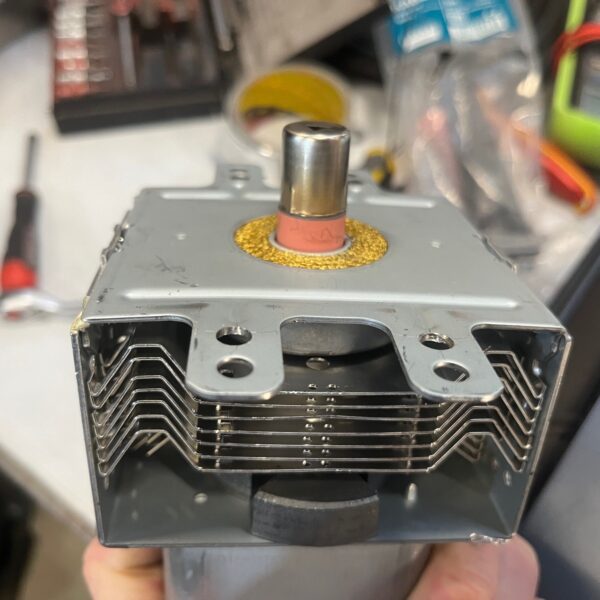
Above is a magnetron that has a cracked magnet that results in a lose of microwave output. This is due the magnetron overheating because of insufficient cooling. If the magnet nearest the antenna was broken then it would be because of reflected microwave from the cavity of waveguide.
What is microwave and how does it work.
How a Magnetron Works.
If you have a question about microwaves or their various applications, looking for pricing information or want to check availability – we’re here to help! Please don’t hesitate to contact us.